Too Many Choices, Not Enough Art: How Creative Abundance Is Quietly Killing Your Vision
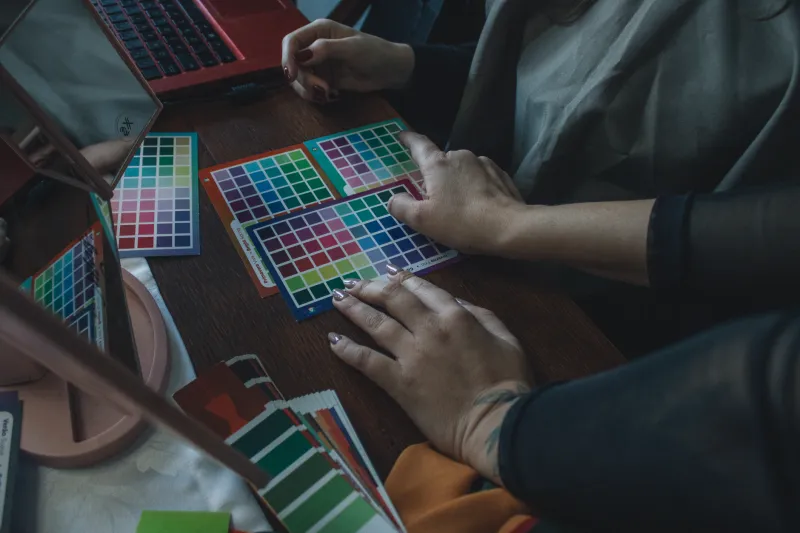
Open any design app right now. Go ahead. You'll find somewhere north of a thousand fonts, hundreds of color palettes, dozens of AI-assisted layout suggestions, and a library of stock imagery so vast it might as well be infinite. Now ask yourself honestly: did any of that make your last project easier to finish?
For a lot of creatives, the answer is an uncomfortable no.
There's a strange irony at the heart of the modern creative experience. We live in the most tool-rich moment in the history of making things. Canva. Adobe Firefly. Midjourney. Figma. Free brushes. Free filters. Free everything. The democratization of creative technology was supposed to set artists free — and in many ways, it has. But it's also handed us a burden nobody warned us about: the paralyzing weight of endless possibility.
When More Becomes Less
Psychologists have a name for this. Barry Schwartz, author of The Paradox of Choice, laid out the argument nearly two decades ago: too many options don't make us happier or more productive. They make us anxious, indecisive, and ultimately less satisfied with whatever we do choose. The phenomenon is called choice overload, and it was originally studied in contexts like grocery shopping and retirement planning. But anyone who's spent 45 minutes picking a font for a poster that took 10 minutes to design knows exactly what Schwartz was talking about.
Neuroscience backs this up. Research out of Columbia University found that when people face too many options, the brain's prefrontal cortex — the region responsible for decision-making — essentially starts to short-circuit. It's not laziness. It's cognitive exhaustion. The more options we evaluate, the more mental energy we burn before we've even started the actual creative work.
For artists, that cognitive tax is especially costly. Creativity requires a certain kind of mental looseness, a willingness to commit to a direction without knowing exactly where it leads. Decision fatigue kills that looseness before the brush ever hits the canvas.
The Scroll That Never Ends
Here's where it gets worse: it's not just the tools themselves. It's the ecosystem around them.
Instagram, Pinterest, Behance, TikTok — every platform is a curated hall of other people's finished, polished, widely-approved creative decisions. Before you've made a single mark on your own work, you've already absorbed thousands of aesthetic choices that other people made. Your brain is pre-loaded with what "good" looks like, and suddenly your own instincts feel suspect by comparison.
Illustrator and muralist Dani Vasquez, based out of Austin, Texas, describes it this way: "I used to spend the first hour of any project just scrolling for 'inspiration.' But I wasn't getting inspired — I was getting intimidated. Every reference I found made my own ideas feel less original, less worth pursuing. I thought I was doing research. I was actually just stalling."
That experience is far from unique. Across creative disciplines — graphic design, photography, textile work, digital illustration — the story repeats itself. More access to reference material hasn't made artists more confident. In many cases, it's made them more hesitant.
The Constraint Comeback
So what do you do when the abundance itself is the obstacle?
A growing number of working artists are landing on the same counterintuitive answer: constraints. Deliberate, self-imposed limitations that shrink the decision space before the work begins.
This isn't a new idea — it's practically ancient. Jazz musicians working within a 12-bar structure. Haiku poets locked into a syllable count. Architects designing for a specific site and budget. Constraints have always been part of creative practice. What's new is the conscious choice to impose them when the tools themselves offer none.
Portland-based graphic designer Marcus Ellery put it plainly: "I give myself a three-color rule for every project now. Three colors, max, before I've even seen the brief. It sounds arbitrary, and honestly, it is. But it cuts the decision tree in half before I've started. Everything downstream gets faster."
Other artists are taking it further. Some photographers are shooting exclusively on film — not for the aesthetic, but for the forced commitment. You've got 24 or 36 frames. You can't spray-and-pray. Every click is deliberate. Some illustrators are limiting themselves to a single brush preset for an entire series. Some writers are drafting in plain text editors with no formatting options at all.
The constraint isn't the point. The freedom the constraint creates is the point.
Building Your Own Walls
If you're feeling the weight of too many options in your own practice, the framework doesn't have to be complicated. A few approaches that working creatives swear by:
Time-box your tool selection. Give yourself five minutes — literally, set a timer — to pick your palette, your medium, your primary tool. When the timer goes off, you're committed. The decision is made. Move on.
Create a personal canon. Rather than scrolling endlessly for reference, curate a small, fixed collection of 10 to 20 works that genuinely speak to your aesthetic. Use only that collection as reference for a set period. You're not cutting off inspiration — you're focusing it.
Embrace the ugly first draft rule. The anxiety of options often stems from wanting the first decision to be the right one. Give yourself explicit permission to make a bad choice on the first pass. Bad choices are reversible. Paralysis isn't.
Audit your toolkit. When's the last time you actually used that seventh plugin, that third stock image subscription, that experimental AI tool you signed up for? Cut what you don't use. A leaner toolkit is a faster toolkit.
The Vision Is the Constraint
There's a deeper point hiding underneath all of this, and it's worth sitting with.
The artists who seem most prolific, most distinctive, most recognizable — they're not the ones with access to the most tools. They're the ones with the clearest sense of what they're trying to say. That clarity acts as its own constraint. When you know what you're after, most of the available options become irrelevant automatically. You don't need to evaluate a thousand fonts because you already know the feeling you're chasing, and most of those fonts don't produce it.
That's the real antidote to creative paralysis. Not fewer tools, necessarily. A stronger point of view.
The good news? Point of view is something you build through making work — even imperfect work, even work you abandon. Every committed creative decision, however small, sharpens the instinct. Every finished piece, however flawed, tells you something about what you actually value.
The tools will keep multiplying. The options will keep expanding. The only way through is to know yourself well enough that most of them stop mattering.
Start there. Pick something. Make it.