How Making Art With Someone Else Teaches You Who You Are Alone

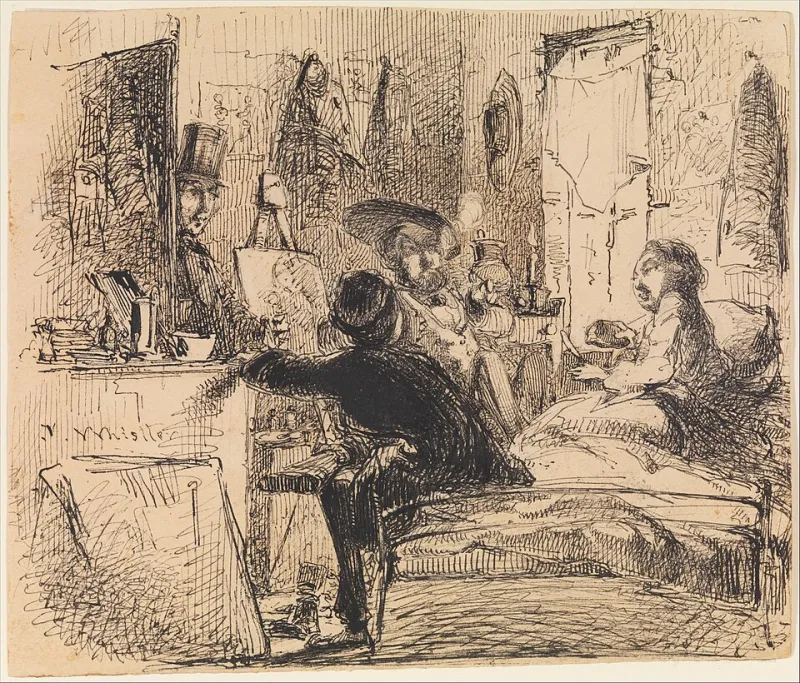
Photo: Frederic Edwin Church, Public domain, via Wikimedia Commons
Here's something nobody tells you in art school: the fastest way to figure out what you actually believe as an artist might be to try making work with someone who believes something different.
Collaboration gets a complicated reputation in creative circles. On one hand, it's romanticized — the legendary partnerships, the artistic duos, the band that changed everything. On the other, there's a persistent mythology of the solitary genius, the lone creator whose vision is too singular to share. Most working artists exist somewhere in the messy middle, suspicious of collaboration but occasionally surprised by what it produces.
What's less talked about is the way a good creative partnership doesn't dilute your individual voice. It clarifies it.
The Friction You Didn't Know You Needed
Think about the last time you had to explain your creative instincts to someone who didn't automatically share them. Not defend them — explain them. There's a difference. Defense is reactive. Explanation requires you to actually understand what you're doing and why.
That moment of articulation — "I want to go darker here because..." or "I think we're overcomplicating this because..." — is one of the most underrated tools in any artist's development. It forces a kind of self-knowledge that working alone rarely demands. When you're solo, you can follow an instinct without naming it. When you're collaborating, instincts have to become decisions, and decisions have to be communicated.
Psychologists call this the protégé effect — the phenomenon where explaining something to someone else deepens your own understanding of it. Collaboration creates a version of that dynamic even between equals. You're not teaching, exactly, but you are constantly translating your internal logic into shared language. Over time, that translation makes the logic clearer to you.
Case Study: What Cross-Disciplinary Work Actually Does
Some of the most interesting creative collisions happen when artists from genuinely different disciplines work together — not just two painters, but a painter and a sound designer, or a graphic novelist and an architect, or a textile artist and a coder.
These partnerships are uncomfortable in the most productive way. Your collaborator doesn't share your assumptions about what a finished piece looks like, what counts as a problem worth solving, or where quality lives in the process. They have a completely different set of instincts, trained by a completely different practice.
Designer and artist Olalekan Jeyifous, whose work moves fluidly between architecture, speculative fiction, and visual art, has talked about how working across disciplines forced him to strip his ideas down to their conceptual core — to find what was essential before figuring out what form it should take. That kind of discipline doesn't come naturally when you're working within a single medium's conventions. It comes from having to make your ideas legible to someone who doesn't share your visual vocabulary.
The result, for Jeyifous and for many artists who work this way, is a solo practice that's more intentional. You know what you're doing. You know why. And you know what you'd fight for if someone pushed back.
What to Actually Look for in a Collaborator
Not every creative partnership is productive, and the difference usually isn't about chemistry or compatibility in the way people assume. It's about a specific combination of shared values and different strengths.
Shared values mean you and your collaborator agree on the why — the purpose or intention behind the work, even if you'd execute it completely differently. Different strengths mean each person brings something the other genuinely lacks, not just a different aesthetic preference, but a different skill set or way of thinking.
What tends to derail collaborations isn't disagreement. It's the wrong kind of agreement — two people with the same strengths and the same blind spots, reinforcing each other's instincts without introducing any productive resistance. That feels comfortable, but it rarely produces work that surprises either of you.
Look for someone who asks questions that genuinely stump you. That's usually a good sign.
Protecting Your Vision Without Closing Off
The real anxiety most artists have about collaboration isn't that it won't work. It's that it will work too well — that you'll lose yourself in it, that your individual voice will get blurred or absorbed, that you'll come out the other side unable to find your way back to your own practice.
That fear is worth taking seriously. But it's also, in most cases, manageable — if you go in with a few clear parameters.
First, know what's non-negotiable for you before you start. Not every element of your practice is equally central to your identity as an artist. Some things are negotiable stylistic habits. Others are core commitments. Knowing the difference means you can be genuinely open about the former without feeling like you're betraying yourself on the latter.
Second, build in solo time alongside the collaborative work. Many artists who collaborate regularly — musicians, filmmakers, visual artists who work with fabricators or assistants — maintain a separate, private practice that nobody else touches. That space isn't a retreat from collaboration. It's the place where you process what collaboration teaches you.
Third, document your own thinking throughout the process. Journals, voice memos, sketches that never get shared — whatever works. The point is to maintain a running record of your individual perspective, even as it evolves in response to someone else's.
The Paradox Resolves Itself
Here's the thing about the collaboration paradox: it only looks like a contradiction from the outside. Once you've been through a genuinely productive creative partnership, the logic becomes obvious.
You can't know what's distinctly yours until you've tried to share it. You can't understand your instincts until you've had to explain them. You can't find the edges of your vision until you've bumped up against someone else's.
The artists who seem most singular — most distinctly themselves — are rarely the ones who worked in complete isolation. They're the ones who went out, made something with someone else, got uncomfortable, learned something, and came back to their own practice with sharper tools and a clearer sense of what they were building.
Solitude is where the work gets made. But collaboration is often where the artist gets made.
And that's not a paradox. That's just how it works.