Proudly Imperfect: How Gen Z Creatives Are Making Analog Mistakes the New Gold Standard
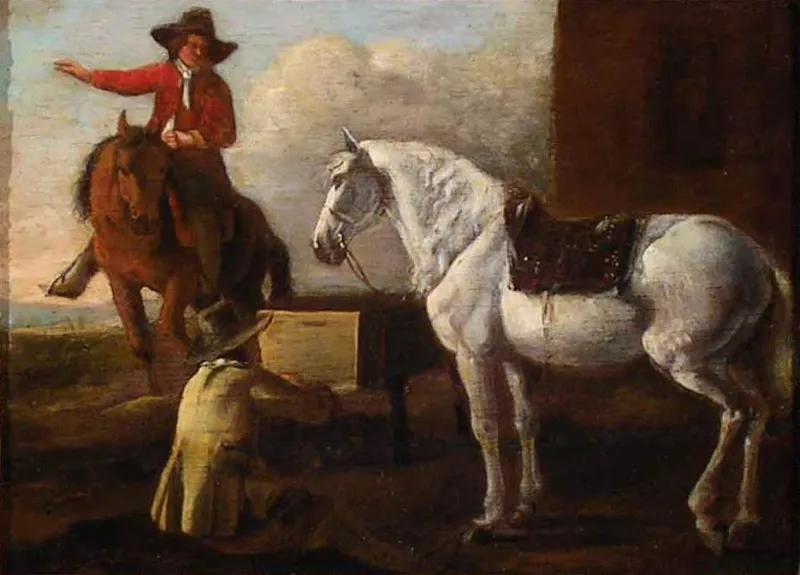
Photo: Abraham van Calraet, Public domain, via Wikimedia Commons
Here's something nobody really predicted: the generation that grew up with the most powerful digital tools in history is increasingly choosing to put them down.
Not all of them, and not all the time. But walk through an emerging artist fair in any major American city right now — the kind where the average exhibitor is under 30 — and you'll notice something. Wobbly hand-lettering. Visible brushstrokes that nobody tried to smooth out. Lino prints with ink bleeding past the edges. Ceramics with fingerprints baked right in. Zines that look like they were made at 2 a.m. with a glue stick and a dream. There's a deliberate roughness everywhere, and it doesn't feel like carelessness. It feels like a choice.
It is a choice. And it's one of the more interesting creative decisions happening in American art right now.
The Algorithm Made Them Do It (By Making Everything Look the Same)
To understand why young artists are running toward imperfection, you have to understand what they're running from. Spend any time on platforms like Instagram or TikTok and you'll notice a kind of aesthetic convergence happening — a smoothing out of individual style into something that performs well on a feed. Clean lines. Even lighting. Symmetrical composition. Colors that pop on a phone screen. It's not that this work is bad, exactly. It's that it starts to look like it was made by the same invisible hand.
That's partly because it kind of was. Algorithmic curation rewards content that looks like other content that already performed well, which creates feedback loops that gently push creators toward certain aesthetics whether they mean to go there or not. Add in the influence of AI image generation — which can produce technically flawless visuals in seconds — and the bar for what counts as "polished" has shifted in ways that make purely technical skill feel less meaningful than it used to.
For a lot of Gen Z artists, the response has been to stop competing on those terms entirely. If the algorithm wants smooth, give it texture. If AI can do perfect, do human. The imperfection isn't a limitation — it's the whole point.
Meet the Makers Embracing the Mess
Take Maya Delgado, a 24-year-old printmaker based in Austin who started selling hand-pulled risograph prints on Etsy a couple years ago. Her work is full of registration errors — the slight misalignment that happens when you print multiple colors by hand and the layers don't land exactly on top of each other. Early on, she thought about trying to fix it. Now she leans into it.
"The misregistration is how you know I made it," she's said in interviews. "It's proof of my hands. A machine would just do it perfectly and there'd be nothing to hold onto."
That idea — imperfection as proof of presence — comes up again and again when you talk to young artists working in analog or semi-analog modes. There's something almost documentary about visible process. A brushstroke that shows the direction of the artist's hand, a ceramic vessel with a thumbprint in the glaze, a painting with a drip that nobody wiped away — these things tell you someone was actually there. They're a kind of signature that can't be faked or replicated at scale.
In Portland, a loose collective of illustrators and zine-makers who call themselves Rough Draft have built a small but dedicated following around work that's explicitly unfinished-looking — sketchy, scratchy, full of crossed-out lines and margin notes left in. Their aesthetic owes as much to old sketchbooks as it does to any contemporary art movement. The appeal, they say, is that it shows the thinking, not just the result.
Why "Flawed" Resonates Right Now
There's a reason this aesthetic is landing particularly hard with post-algorithm audiences, and it goes beyond nostalgia or counterculture posturing. We're living through a moment of genuine uncertainty about what's real — what's been generated versus made, what's authentic versus optimized. In that environment, evidence of human fallibility is actually reassuring. A mistake is proof of a person.
Psychologists have a term for this: the pratfall effect. Research has shown that competent people become more likable when they make small mistakes because the error makes them feel more relatable and real. The same principle seems to apply to art. A painting that shows struggle — that lets you see where the artist changed their mind, or where the hand slipped — invites you into a relationship with the maker in a way that a perfectly resolved image doesn't.
This might also explain why handmade goods broadly have held their value (and often increased it) in an era of mass digital production. There's a Substack-era equivalent happening in visual art — a premium being placed on things that feel genuinely personal, even if they're less technically impressive than what a software tool could produce.
This Isn't Anti-Tech — It's Pro-Human
It's worth being clear that this isn't really about rejecting technology. Most of the artists driving this movement use digital tools at some point in their process — to document their work, to share it, to handle the business side of being a creative. The rebellion isn't against screens. It's against the flattening of individual voice that happens when everyone's using the same tools toward the same aesthetic ends.
What Gen Z artists are really asserting is that the human element has value that can't be automated. That the wobble in a hand-drawn line communicates something a perfectly rendered vector curve doesn't. That the choice to show your process, your errors, your revisions — rather than hiding them behind a finished surface — is itself a creative act.
In that sense, this isn't a retreat from contemporary art practice. It's a very contemporary argument about what art is for, and who it's made by. The answer these artists are giving is: it's made by people, it should look like it, and the mess is the message.
Honestly? It's a pretty compelling manifesto for a movement that never sat down to write one.