The Graveyard of Good Ideas: Why Your Failed Projects Are Your Most Valuable Asset
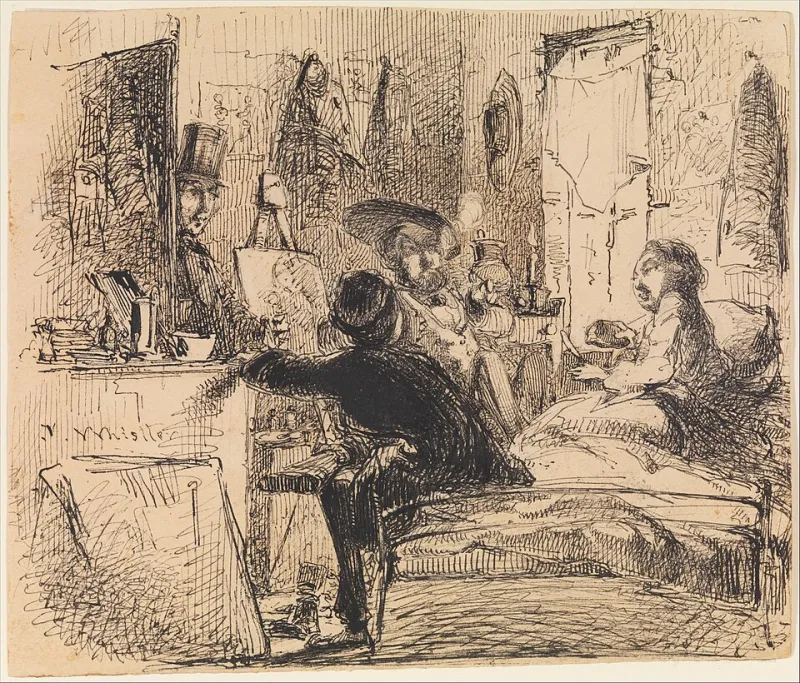
Photo: James McNeill Whistler, CC0, via Wikimedia Commons
Every creative has one. A folder — digital, physical, or just mental — full of things that didn't work out. The commission that got cancelled three weeks in. The concept you pitched twice and got ghosted on both times. The personal project you were genuinely excited about until you weren't, and then quietly buried somewhere you didn't have to look at it.
We call this stuff failure. We treat it like creative landfill.
I think that's one of the biggest mistakes working artists make.
The Finished-Work Obsession
Creative culture — especially in the US, where hustle mythology runs deep — has a serious case of completion bias. We celebrate the launch, the opening, the published piece, the shipped product. Portfolios are built from wins. Instagram feeds are curated highlight reels. Even the "vulnerability" content that performs well online tends to follow a redemption arc: I struggled, and then I figured it out, and here's the finished thing that proves it.
What we almost never talk about is the stuff that just... ended. Not with a lesson. Not with a pivot that led somewhere better. Just ended.
And because we don't talk about it, we don't look at it. And because we don't look at it, we miss what's actually in there.
What Failed Projects Are Actually Made Of
Here's the thing about a cancelled commission or an abandoned concept: it contains real work. Real thinking. Real decisions you made under pressure, with limited information, trying to solve a problem that genuinely mattered to you at the time.
That doesn't evaporate just because the project didn't cross a finish line.
Consider the illustrator who spent six weeks developing a visual language for a book cover project that ultimately got killed when the publisher pulled the title. The project failed. But those six weeks produced a color palette she'd never used before, a texture technique she'd been experimenting with, and a compositional approach that felt genuinely new. None of that lived in the final (non-existent) deliverable. It lived in the process files she almost deleted.
Or think about the muralist who submitted a proposal for a major public art commission in Chicago and didn't get it. The rejection stung. But the research he did for that proposal — the deep dive into the neighborhood's history, the visual references he pulled, the scale studies he worked through — became the foundation for a completely different series of paintings that ended up being some of the strongest work of his career.
The proposal failed. The thinking didn't.
Why We Bury It Instead of Mining It
So why don't we go back? Why does the graveyard of good ideas stay mostly unvisited?
Part of it is emotional. Failed projects carry a specific kind of weight — not just disappointment, but the particular sting of something you cared about not working out. Going back through those files means going back through that feeling, and most of us would rather just move forward.
Part of it is practical. When you're busy, the next project always feels more urgent than the last failed one. There's no client waiting for you to excavate your rejection folder. No deadline forcing the reflection.
And part of it is a story we've absorbed about what failure means — that it's the opposite of success rather than a different kind of data. We treat a rejected proposal like a verdict on the idea itself, when really it's just information about one particular context, one particular moment, one particular decision-maker's priorities.
The idea might still be good. The work might still be useful. You just haven't looked yet.
A Practical Framework for Mining Your Failures
If you want to actually turn your creative graveyard into a working resource, here's a loose framework that a lot of artists find useful.
Give it time, then go back. The worst moment to evaluate a failed project is right after it fails. The emotional static is too loud. Give yourself a few weeks — or a few months for the bigger ones — and then revisit with fresh eyes. You'll be surprised how differently things look.
Ask what you were actually solving. Strip away the specific context of why the project failed and look at the underlying problem you were trying to address. Was there a visual challenge in there that's still interesting? A conceptual question you never fully answered? That unresolved tension might be exactly the starting point for something new.
Inventory the raw material. Go through the process files, the sketches, the reference pulls, the early drafts. You're not looking for finished work — you're looking for fragments. A color study you loved. A structural decision that felt right even if the whole thing didn't. A line of thinking that got abandoned too early.
Ask what you learned that you didn't know you learned. Failed projects teach you things in real time that you often don't consciously register until later. What did working on that cancelled commission teach you about how you handle client ambiguity? What did that rejected proposal reveal about a gap in how you communicate your ideas? The meta-lessons are often as valuable as anything visual.
Recombine deliberately. The most exciting thing you can do with failure fragments is put them in conversation with each other. Take the color palette from the killed book cover and the compositional approach from the rejected mural proposal and see what happens when they meet in something new. Cross-pollinating your own failures is one of the most underrated creative strategies out there.
Reframing the Finish Line
Maybe the deepest shift here is philosophical. We've built a creative culture that treats the finished, public-facing work as the only legitimate output of the creative process. Everything else — the experiments, the abandoned directions, the failed pitches — gets classified as waste.
But working artists know that the process is where most of the actual thinking happens. The finished piece is just the version of the thinking that got resolved. All the versions that didn't get resolved are still thinking. They're still real. They still happened.
Your graveyard isn't a record of your failures. It's an archive of your creative intelligence operating under pressure, in uncertainty, without a guaranteed outcome.
That's not garbage. That's research.
Start treating it that way.