The Work You Won't Post Is Trying to Tell You Something
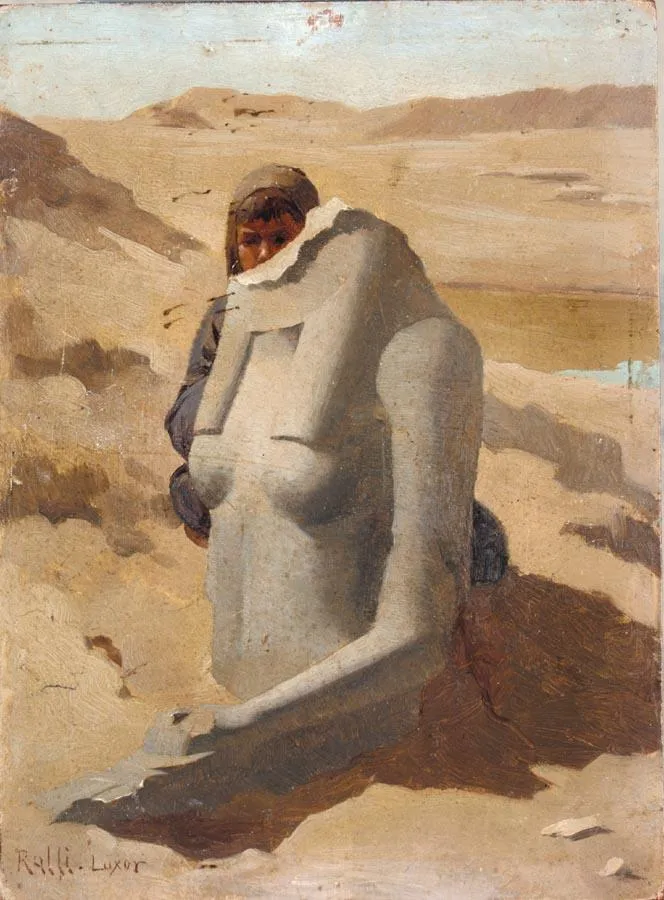
Photo: Théodore Ralli, Public domain, via Wikimedia Commons
The piece is finished. It's leaning against the wall in the back of the studio, or sitting in a folder on your desktop with a name like final_final_actually. You've shown it to one person, maybe two. You have not posted it. You have not put it in a portfolio. You have not submitted it anywhere.
That's the one. Not always, but often enough to be a pattern.
At Madhur Arts, we're interested in contemporary work that takes a risk. Risk doesn't always look dramatic. Sometimes it looks like a painting that doesn't match your usual palette. Sometimes it's a series that admits you were wrong about something. Sometimes it's a piece that's so close to your own experience that showing it feels like walking into a room without a coat.
Fear Is a Terrible Curator
Fear is very good at making arguments. It says the work is too weird, too personal, too unresolved, too much. It says the market won't get it. It says your collectors will be confused. It says wait until you've made more work like it — which is a clever way of saying never.
But fear is not a curator. It doesn't have a thesis. It doesn't know your audience. It just knows how to keep you safe. And safe work is rarely the work that moves anyone.
The Pieces We Hide Are Usually the Ones With a Pulse
Think about the last piece you hesitated to show. What was the hesitation about? If it was technical — the edges aren't right, the color is off — that's a craft problem, and craft problems are solvable. If it was emotional — this reveals too much, this is too strange, this doesn't fit my brand — that's a signal.
The work we hide often holds the thing we're actually trying to say. It's the piece where the influence broke open instead of staying polite. It's the one where the composition got awkward because you were following an instinct instead of a formula. It's the one that made you nervous in the studio, which is usually a sign that something real is happening.
Why Original Work Feels Risky
Original work is risky because it hasn't been validated yet. There's no reference point. No collector has bought it. No curator has posted it. No algorithm has told you it's good. You're standing in front of something new, and the only evidence you have is your own judgment.
That's uncomfortable. It's also the job.
The artists who build lasting careers aren't the ones who never feel fear. They're the ones who learn to distinguish between fear of criticism and fear of exposure. Criticism is useful. Exposure is just the cost of doing business as a creative person.
Test the Waters Before You Dive
You don't have to launch the scary piece at a museum gala. You can test it with a small, trusted audience first. Here's a low-stakes plan:
- Show it to two or three people whose taste you respect, not people who automatically agree with you.
- Post it in a story or a private group, not a permanent grid post.
- Put it in a studio newsletter with a note about why it was hard to make.
- Bring it to a local open studio or a small group show where the stakes are low.
- Offer it to a collector who already trusts your eye, with a simple explanation of what it is.
The point isn't to gather votes. The point is to get the piece out of your head and into a room where it can be looked at. Most of the time, the response will be less dramatic than you imagined. Sometimes it will be better. Occasionally it will be confusing. All of that is data.
What If They Don't Get It?
Some people won't get it. That's fine. The piece wasn't made for everyone. The question is whether the right people get it. If you show it to ten people and two of them respond with real curiosity, you've found your audience. If no one responds, you've learned something about the work — or about the room you showed it in.
Don't confuse silence with failure. Sometimes the work is ahead of the room. Sometimes the room is just distracted.
Show the Thing
The safest work is the work that never leaves the studio. It's also the work that never does anything. The piece you're afraid to show is not a problem to solve. It's an invitation. It's asking you to trust your own eye enough to let other people look.
So show the thing. Not because it's perfect, but because it's yours. The work you're hiding might be the one that finally says what you've been trying to say.