Leave the Pile Alone: A Working Artist's Case Against the Showroom Studio
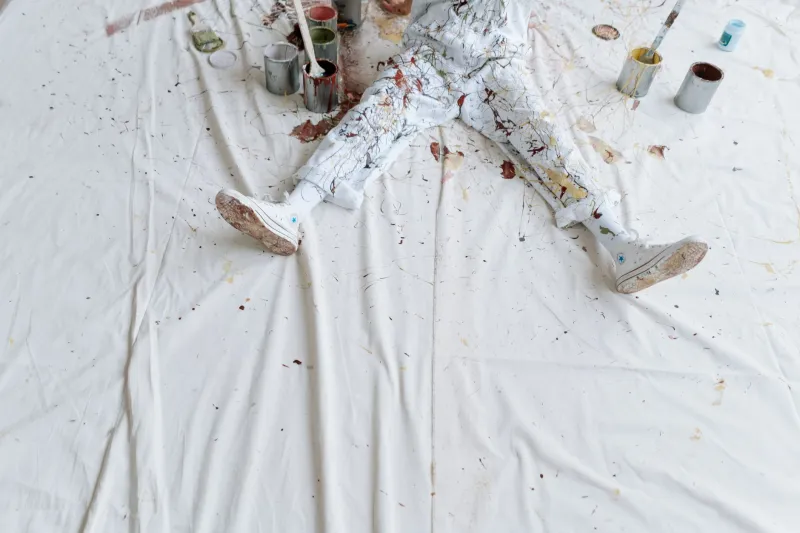
On a Tuesday afternoon this past October, Dana Whitfield opened the door to her studio in Philadelphia's Kensington neighborhood and immediately started apologizing. For the paint cans. For the stack of canvases leaning four deep against the radiator. For the coffee cup from, she guessed, sometime in August.
I hadn't asked. She apologized anyway. “I follow all these painters online with the white walls and the one ceramic vase and I think, what is wrong with me,” she said, clearing off a folding chair. “Then I remember — they're probably not painting.”
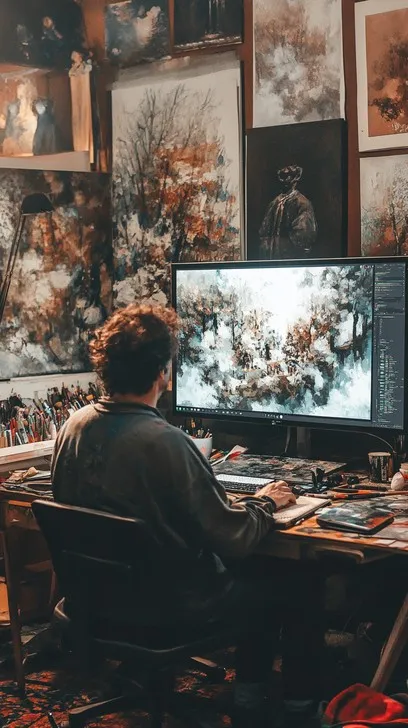
That gap between the studio we perform and the studio we actually work in has become one of the stranger pressure points of creative life in 2026. The clean-studio aesthetic is a full-blown genre now: exposed brick, a single stem of eucalyptus, brushes arranged by size like a knife roll. It photographs beautifully. It also implies that mess is a failure of discipline rather than a byproduct of thinking out loud.
Three Artists, Three Different Flavors of Chaos
Whitfield, who paints large, layered abstractions and shows with a couple of regional galleries, works on eleven canvases at once. They live in loose clusters around the room, not stacked by date or series. “My piles are compost,” she said. “Something rots down in there and feeds the next thing. If I filed everything neatly, I'd never stumble onto the accident I'm actually looking for.”
In Detroit, sculptor Marcus Oyelaran has a system, technically. It consists of four plastic bins labeled YES, MAYBE, and LATER — the fourth is unlabeled and he'd like to keep it that way. He doesn't sort by material or size; he sorts by emotional charge. “The bin is not storage,” he told me. “It's a conversation I'm having with myself across two years. Filling out a label maker isn't going to improve my sculpture.”
Priya Raghunathan, a printmaker in Portland, Oregon, has the most radical approach of the three: her floor is the drying rack, and she keeps what she calls a dead layer shelf — a plank of bad proofs, failed monotypes, and smeared test sheets that she refuses to throw out. “Every studio needs a place where bad ideas can retire with dignity,” she said. “Half of my good prints started as a stain on something I was about to trash.”
The Business Case for the Beautiful Dump
Here's the part that gets left out of the tidy-studio narrative: mess is often labor you haven't invoiced yet.
A cluttered studio is a research archive. It's the proof that you tried six things before the seventh worked. Collectors who visit in person — and plenty still do, especially at the mid-career tier where relationships get built — respond to that. They aren't buying a lifestyle brand. They're buying evidence of a mind at work.
It's also content. The half-finished experiment on the back wall is next month's studio-notes post, next season's newsletter, next year's series. Artists who document their own chaos end up with a back catalog of process imagery that a clean studio simply cannot generate, because nothing in a clean studio looks like it's in the middle of becoming something.
And there's speed. Whitfield put it bluntly: “When everything is out, I can pull a painting forward without opening a single drawer. The mess is my search engine. The search engine doesn't work if you keep shutting it off.”
Practical Takeaways for the Guilt-Ridden
You don't have to live in a landfill to stop apologizing for your floor. A few things that actually help:
Zone, don't systematize. Agree with yourself that one corner is for drying, one table is for mixing, one shelf is for things you're actively avoiding. Zones survive real work; elaborate filing systems don't.
Run a twenty-minute reset, not a deep clean. Before a studio visit, clear walking paths and one surface. That's it. Nobody needs to see the closet.
Label by date, not category. A bin marked MARCH is more useful than a bin marked MISC. You'll remember what you were thinking in March.
Keep one shelf for the dead. Bad work needs somewhere to go that isn't the trash and isn't your desk. A dead shelf honors the effort and keeps the failure close enough to learn from.
Don't buy storage before you know what you keep. Most studio organization products are designed for people who don't make things.
Photograph the pile before you break it down. You'll want to remember what the accumulation looked like when the next series starts pulling from it.
The Room Is a Workshop, Not a Showroom
What all three artists kept circling back to is that the mess is not a moral category. It's a working condition. A studio with nothing on the floor is a studio where nothing is happening — or, more generously, a studio belonging to someone whose practice is mostly digital, or who cleans obsessively before every photo shoot.
Whitfield has stopped apologizing as much. Last spring she hosted a small collector dinner among the paint cans and half-finished panels, and sold two pieces off the wall that hadn't even been framed. “The mess did half the selling,” she said. “People could see how the work got made. That's more persuasive than a price list.”
So if you're a creative person who has been quietly ashamed of your own floor, consider this a permission slip. Tidy up the walkway. Leave the pile. It's not a secret. It's the job.