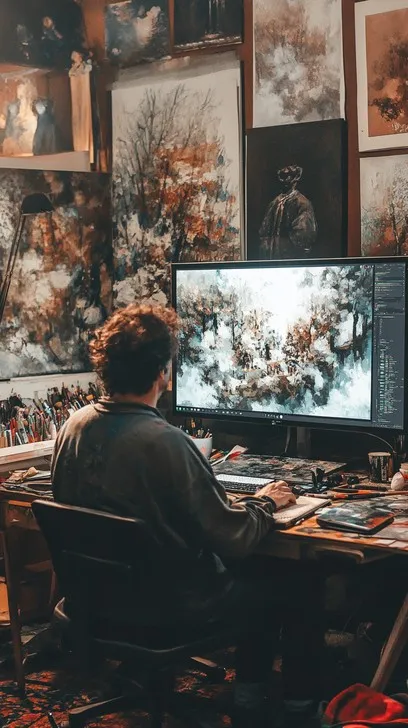
Your Living Room Is Now a Gallery, a Warehouse, and a Fortune: Inside the Home-Studio Business Boom

Photo: artist packing painting in home studio with bubble wrap, via cypaint.com
There's a moment every artist who sells from home eventually faces. It usually involves a stranger's money, a painting leaning against your radiator, and the sudden realization that you are now, technically, a shipping department.
That moment — equal parts thrilling and absurd — is the entry point for what might be the most significant shift in the American art economy in decades. Across the country, artists are skipping the gallery system entirely, selling original work straight from apartments, garages, and converted dining rooms. No jury, no commission split, no waiting two years for a group show. Just work, a phone camera, and a mailing label.
It sounds scrappy because it is. But scrappy isn't the same as unprofessional. The artists doing this well have quietly built systems that rival small businesses in any other industry. Here's what that actually looks like.
The Mindset Flip: From 'Person Who Makes Things' to 'Person Who Ships Things'
The hardest part of selling from home isn't pricing or marketing. It's the identity shift.
Hobbyists make art and then decide what happens to it. Business owners make art knowing it has a destination. That sounds small, but it changes everything downstream — how you photograph a piece, how you document it, how you price it, even how you sign it.
Ask any artist who's crossed this line and they'll tell you about the first sale. Not the first sale to a friend or a family member, but the first sale to a stranger in a state they've never visited. Something clicks. The work was always real; now the market agrees.
The practical version of this shift: start treating your output like inventory. Photograph everything. Catalog everything. Know where every finished piece is at all times. Boring? Absolutely. But you can't run a business on pieces you can't find.
Pricing Without the Panic
Home-based artists have one enormous advantage over galleries: no 50% commission. But most squander it by underpricing out of fear.
A saner approach starts with a simple floor calculation. Add up your materials, your time at an honest hourly rate, and your overhead — the packaging, the platform fees, the portion of your rent that covers your workspace. That's your break-even. Anything below it isn't generosity; it's a slow leak.
From there, pricing gets psychological, and this is where home-based sellers often get it backwards. A common instinct is to keep early prices low to 'build an audience.' But buyers — especially American buyers shopping online — read price as a signal of quality. A $60 original reads as a craft fair impulse buy. A $340 original reads as art. Same painting. Different story.
A few tactics that consistently work:
- Price by size, not by feeling. A consistent per-square-inch or per-linear-inch rate removes the emotional spiral from every new piece.
- Raise prices in steps, not leaps. Ten to fifteen percent after every sellout of your current tier. Buyers who missed out learn that waiting costs money.
- Never discount originals. Ever. Prints can go on sale. One-of-a-kind work that drops in price trains your audience to distrust your pricing — and insults everyone who paid full price last month.
The Unsexy Middle: Packing, Shipping, and Not Losing Money
Here's the part nobody romanticizes. You've sold a 24x30 canvas to someone in Portland. Now what?
First, weigh your options before you promise anything. USPS Priority Mail, UPS Ground, and FedEx all price differently depending on size and distance, and oversized art hits dimensional weight thresholds that can turn a $20 quote into $80 reality. Buy a shipping scale before you list anything. Build realistic shipping into your price or your checkout — 'free shipping' that eats your margin is just a discount with better marketing.
Second, learn to pack like your reputation depends on it, because it does. The home-studio standard for framed or canvas work: glassine or parchment over the surface, corner protectors, a layer of bubble wrap with the bubbles facing out (yes, out — it prevents surface impressions), then a double-walled box or a telescoping art box with two inches of cushion on every side. Add a handwritten note. It costs you ninety seconds and it's the difference between 'transaction' and 'experience.'
Third, insure anything over $100 and photograph the packing process. If a carrier destroys a piece, documentation is the entire argument.
Where the Buyers Actually Are
The channels matter less than the consistency. Instagram remains the primary discovery engine for original work — Stories do the selling, the grid does the credibility. Etsy brings traffic but takes fees and trains buyers to haggle. A personal site with a simple shop page converts better than either, because it's the only channel where the buyer's only option is you.
The artists who thrive run all three like a funnel: social platforms create familiarity, the personal site closes the sale, and email — the most unglamorous tool in the stack — brings people back for the next drop.
And that's the real secret hiding inside the home-studio boom. The living room was never the point. The point is that for the first time, an artist can own the entire relationship: making, marketing, selling, shipping, and the thank-you note at the end. It's more work than anyone admits. It's also more freedom than the art world has ever offered a working painter.
The gallery has a couch in it now. Turns out that's fine.