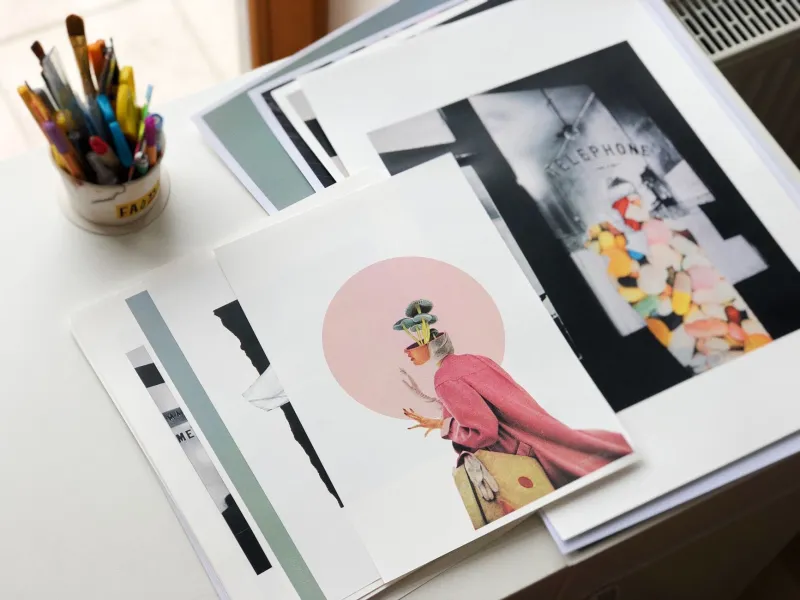
Your Finished Work Is Just a Draft: The Artists Who Never Stop Remixing Themselves

There's a moment most artists know well — you sign off on something, post it, ship it, frame it, and then walk away. Done. Finished. Onto the next thing. The piece enters the world and you enter a kind of creative amnesia about it, already moving forward.
But a certain kind of artist refuses to let that be the whole story.
Increasingly, the creatives generating the most interesting work aren't just making new things — they're looping back into what they've already made, pulling it apart, feeding it into new contexts, and seeing what comes out the other side. It's less like a traditional artistic practice and more like a DJ set that never actually ends.
The Catalog as a Living System
Here's the reframe that changes everything: what if your finished work wasn't a product but a resource?
Musicians figured this out decades ago. Hip-hop built an entire genre on the idea that a great sample is worth more than a throwaway original. Producers like J Dilla and Madlib didn't just sample other people's records — they looped back into their own archives, recontextualizing their sounds across projects, years, even decades. The catalog became a living system rather than a collection of closed chapters.
Visual artists and designers are catching up fast. Painters who photograph their canvases mid-process and use those images as the basis for digital works. Illustrators who take a finished character design and push it through completely different aesthetic filters — risograph, woodblock, neon line art — not to improve the original, but to discover what it becomes. Photographers who revisit negatives from five years ago with entirely new darkroom techniques or editing philosophies.
The completed piece isn't the endpoint. It's more like a checkpoint.
Why This Isn't Just Recycling
There's a lazy version of this idea, and it's worth naming. Just slapping a filter on an old piece and reposting it isn't what we're talking about here. That's content strategy, not creative philosophy.
The deeper version involves returning to finished work with genuinely changed eyes. You've grown since you made that thing. Your influences have shifted. Your relationship to color, form, narrative, or texture has evolved. When you go back into old work carrying all of that new weight, you're not repeating yourself — you're in dialogue with who you were.
That's a fundamentally different creative act.
Think about how Beyoncé operates across albums, visuals, and live performances. Or how Kehinde Wiley keeps returning to the formal language of Old Master portraiture, not recycling it but continuously interrogating it — stretching it, complicating it, making it answer for itself in new contexts. The source material is consistent. The conversation keeps moving.
For independent artists, this approach carries a specific kind of freedom. You don't have to manufacture novelty from scratch every time. Your back catalog is already full of raw material that no one else has access to — because it came from you, and only you understand its full context.
The Medium Hop as Creative Tool
One of the most productive versions of this practice is what you might call the medium hop — taking work made in one form and deliberately translating it into another, not for reproduction but for transformation.
A digital illustration becomes a screen print. A screen print gets photographed in a specific light and becomes the background layer of a mixed-media piece. That mixed-media piece gets deconstructed and reassembled as an animation. At every stage, the original image is still recognizable — but it's accumulated context, texture, and meaning that it didn't have before.
Artists who work this way often describe something surprising: the translation process reveals things about the original work that they couldn't see when they were inside it. Constraints of a new medium force different decisions. A painting that felt resolved suddenly has unresolved edges when you try to render it as a textile. That friction is information.
And sometimes the translation is the best version of the idea.
The Philosophy Behind the Loop
There's a worldview embedded in this approach that's worth making explicit.
It pushes back against the idea that creative work has a singular, final form — that there's one correct version of a piece and everything else is a lesser copy or a departure. That belief puts enormous pressure on every creative decision and treats the finished work as something sacred and untouchable.
The remix mindset replaces that with something more fluid. Finished means finished for now. The work exists in a particular form at a particular moment, and that form has value — but so does what it becomes next.
This tracks with how a lot of contemporary artists actually experience their own development. You don't make a clean break from your old work and start fresh. You carry it with you. Your influences stack up. Your obsessions resurface. The things you thought you were done with have a habit of showing back up in new clothes.
Leaning into that, rather than fighting it, is what the cyclical approach is really about.
Starting Your Own Loop
If this sounds appealing but you're not sure where to begin, the entry point is usually simpler than it seems.
Pull up something you made at least a year ago — something you considered finished and then more or less forgot about. Look at it like you're a stranger encountering it for the first time. What's still working? What feels incomplete in a way you couldn't see back then? What would you do differently now, not to fix it, but to push it somewhere new?
You don't have to destroy the original. The original already exists. What you're making is a response to it — a conversation with your past self conducted through the work itself.
That's not a lack of originality. That's one of the most honest things a creative person can do.
Your catalog isn't an archive. It's a starting point, over and over again. The remix never really sleeps — and maybe it shouldn't.