Blink and You'll Miss It — Or Will You? The Surprising Depth of Micro-Format Art
There's a weird thing that happens when you watch a really good six-second video clip. You replay it. And then you replay it again. And somewhere around the fourth loop, you start noticing things you missed the first three times — a shadow, a color choice, a tiny gesture that reframes the whole thing. That's not accidental. For a growing wave of contemporary artists, that loop is the art.
We've been told for years that shrinking attention spans are the enemy of meaningful creative work. But what if that's the wrong frame entirely?
Speed Isn't the Villain Here
The cultural hand-wringing over short-form content tends to assume that faster consumption equals shallower engagement. But artists working at the intersection of digital platforms and fine art are proving otherwise. When you design something to exist in a moment — a Reel, a GIF, a single-panel illustration — you're not dumbing it down. You're compressing it. And compression, in art, has always been a form of intensity.
Think about haiku. Think about a Rothko field painting that takes two seconds to see and twenty minutes to feel. The container being small doesn't mean the content is thin. If anything, constraints tend to sharpen creative decisions in ways that sprawling formats don't demand.
Contemporary artists navigating platforms like TikTok and Instagram aren't just adapting to the algorithm. The smart ones are using the algorithm's rhythm as a compositional tool — timing a color reveal to hit at the exact moment a viewer's thumb would naturally pause, or building visual tension that resolves just slowly enough to make someone stop mid-scroll.
The Double-Exposure Effect
Here's where it gets interesting from a theory standpoint. A lot of the most compelling micro-format work right now is built with what you might call a double-exposure effect — it reads one way at speed and another way entirely when you slow down.
This isn't a new idea in art history. Flemish painters hid symbolism in backgrounds that most viewers never noticed. Street murals contain detail that only reveals itself at close range. What's new is the intentional design of two distinct experiential layers for two distinct modes of attention — the scroll and the study.
Artists like Madhur are working in exactly this space, creating pieces that function as visual one-liners at first glance but unfold into something more textured when you actually sit with them. A digital illustration might land as a clean, punchy image in your feed — but zoom in, and there's a whole conversation happening in the linework, the negative space, the color relationships. The quick viewer gets something real. The slow viewer gets more. Neither experience is lesser.
Gallery Walls Are Catching Up
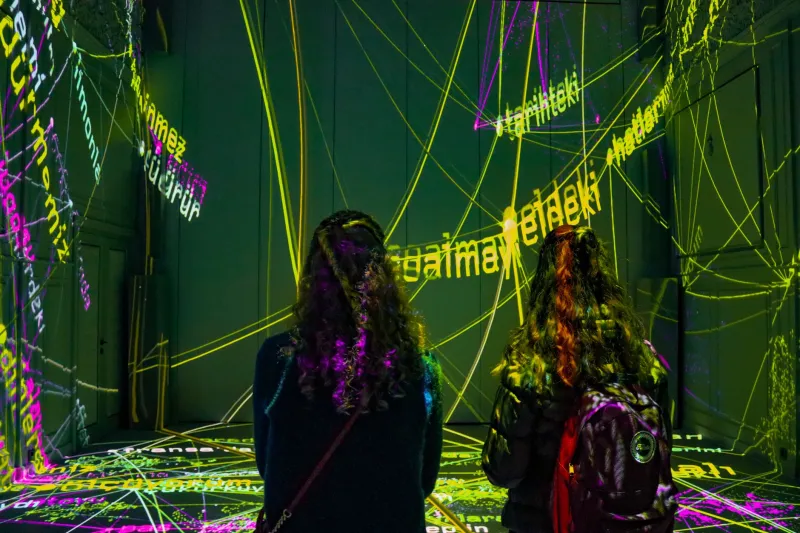
This philosophy isn't staying online. Physical gallery installations are increasingly designed with the same dual-register thinking. Short-attention-span culture has actually pushed some installation artists to reconsider the implicit demand that viewers spend ten minutes contemplating every piece. Instead, work is being designed to be activatable — meaningful on entry, richer with investment, but never punishing to the person who only has thirty seconds.
Some galleries in cities like New York and LA are experimenting with what curators are calling "tiered engagement" — labels that give you a one-sentence read if you want it, a deeper dive if you pull out your phone, and an audio layer if you really want to go down the rabbit hole. The art doesn't change. The access points multiply.
This is a genuinely democratic shift. The old gallery model quietly gatekept deep engagement behind cultural fluency — you had to already know the references to get the layers. Tiered engagement design opens that up without flattening the work for people who do bring that fluency.
What This Reveals About How We Actually Look at Art
Here's the honest truth that art institutions have been slow to reckon with: people have never, on average, spent more than a few seconds in front of most museum pieces. Studies tracking visitor eye movement and dwell time have shown this for decades. The idea that audiences used to engage deeply and now don't is largely a myth built on nostalgia for a golden age of contemplation that mostly existed for a very small, very specific demographic.
What's changed isn't attention spans in some neurological sense. What's changed is that artists can now see their audience's behavior in real time. Metrics, comments, saves, replays — these are feedback loops that painters in 1920 never had. And some artists are using that data not to chase engagement, but to understand the actual rhythm of how people move through visual experience.
That's a tool, not a trap. The artists who treat it like a trap end up either chasing trends or retreating into deliberate obscurity as a form of resistance. Neither move is particularly interesting. The artists who treat it like a tool are making work that meets people where they actually are — and then quietly asks them to go further.
The Invitation, Not the Demand
Maybe that's the cleanest way to think about what micro-format art at its best is actually doing. It's not demanding your attention. It's not performing depth to impress you. It's extending an invitation — here's something that works right now, in this second, for you exactly as you are. And if you want more, there's more.
In a cultural moment where so much creative work is either screaming for attention or deliberately withholding itself, that kind of generous, layered design feels quietly radical. The blink and the stare can coexist. They always could. We're just finally building for both.